
Male breast reduction is designed to reduce excess fullness in the chest and create a flatter, more masculine chest contour.
Treatment planning depends on whether the fullness is caused mainly by fat, gland tissue, excess skin, or a combination of these, and on the kind of chest shape that can be achieved safely and naturally.
Starting from 135,000 THB (~ 4,090 USD)

Male breast reduction, also called gynecomastia surgery, is designed to reduce excess breast fullness in men and improve chest contour.
Depending on the cause and severity, treatment may involve liposuction, gland removal, skin reduction, or a combination approach. Mayo Clinic notes that liposuction removes breast fat but not gland tissue, while mastectomy removes gland tissue and may be used alone or together with liposuction.
Liposuction is used when chest fullness is caused mainly by excess fat.
Patients whose chest fullness is more fat-dominant and who do not need gland removal alone.
Patients with more gland-based fullness are unlikely to improve with mliposuction alone
Patients who need more complete chest contouring through both fat reduction and gland removal.
Patients with more severe gynecomastia, skin excess, or a chest that has stretched over time.
ASPS notes that in more severe gynecomastia, excess tissue weight can stretch the areola and cause sagging, which may require skin reduction or adjustment of the areola position and size.
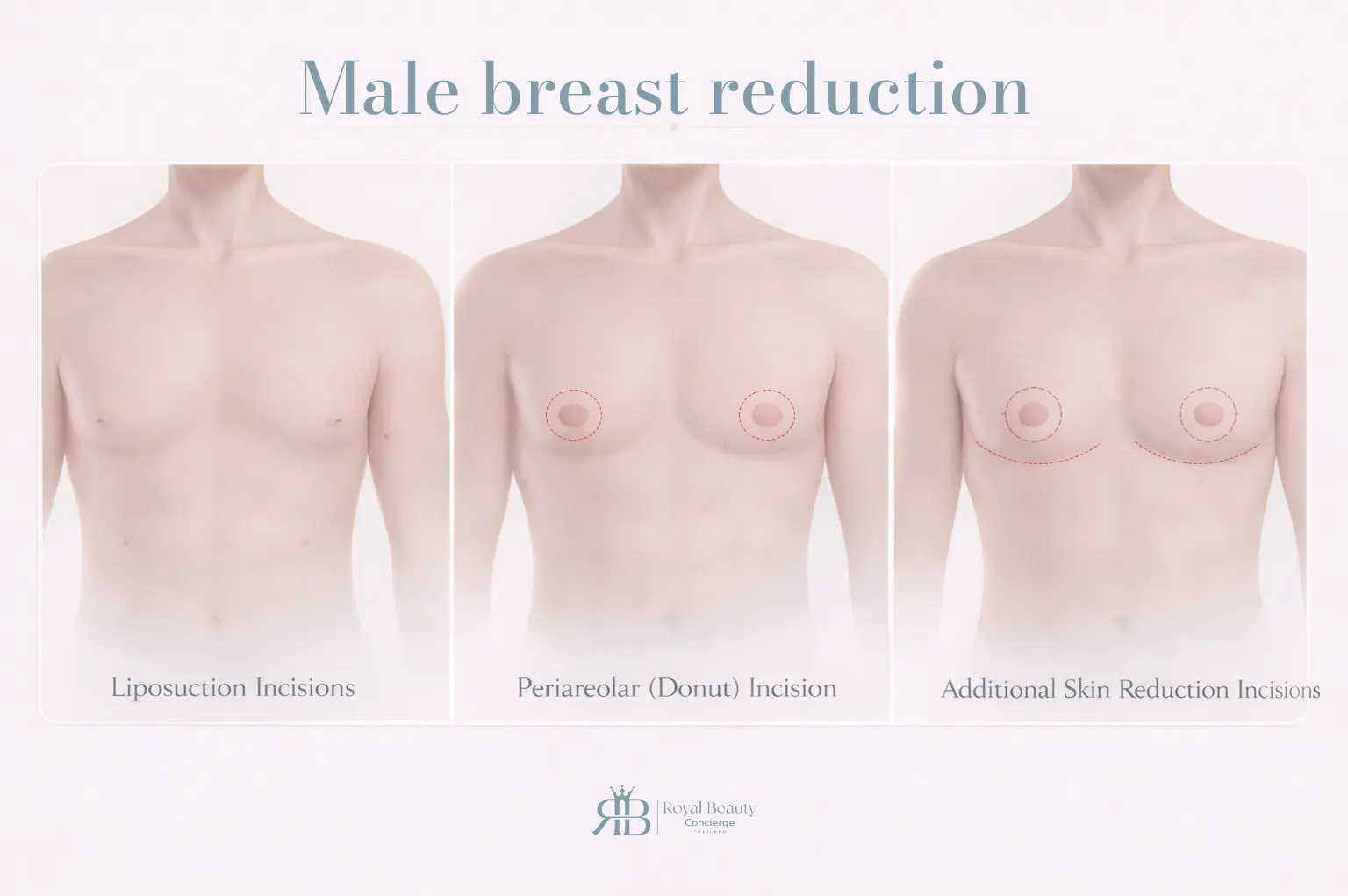
Small incisions are placed in discreet areas to allow fat removal.
An incision is placed around the lower edge of the areola or nearby to allow gland removal.
In more significant cases, extra incisions may be needed to remove skin or reshape the chest more effectively.
Male breast reduction is designed to improve:

Your case is reviewed by the surgeon who performs your procedure, with planning based on your anatomy, tissue composition, degree of chest fullness, recovery period, and medical suitability.

Male breast reduction is performed in a private hospital in Bangkok, Thailand, with anaesthesia care and post-operative monitoring built into the process.
Swelling, tightness, bruising, and mild discomfort are common.
Early healing is reviewed, and many patients begin to feel more comfortable.
Swelling may still affect contour, and compression is usually still part of early recovery.
The chest usually begins to look flatter and more settled over time, although final refinement takes longer.
Male breast reduction can create meaningful improvement in chest shape, but it is still real surgery.
Cleveland Clinic and ASPS list risks such as excessive bleeding, infection, asymmetry, bruising or scarring, contour irregularities, sensation changes, seroma, and need for additional treatment in some cases.
The goal is to choose the right treatment plan, operate carefully, and support healing safely.